Avalanche Transceiver
Symbolbild (Stockfoto); nicht das abgebildete Produkt.
It Only Works If Everybody Has One
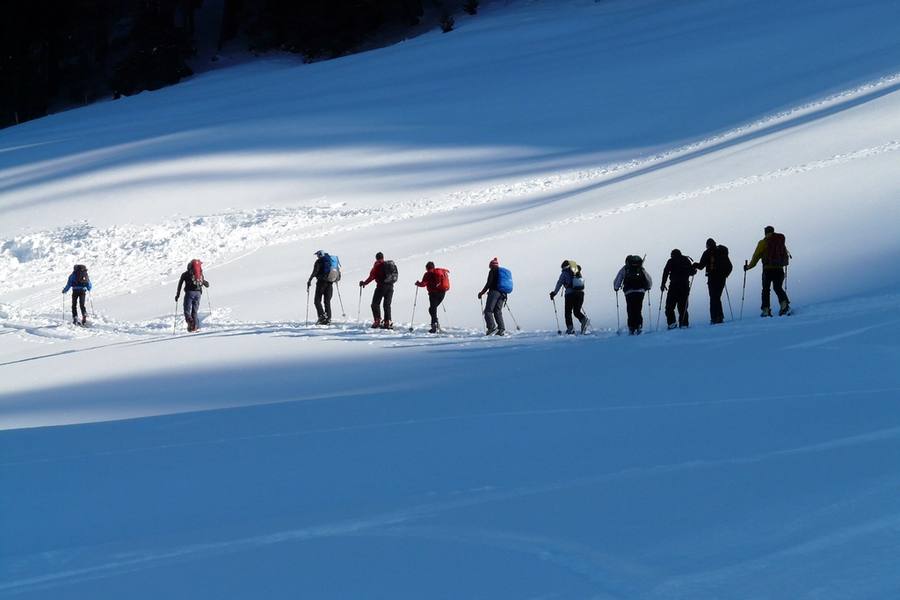
A transceiver transmits a signal so that companions can find you and receives so that you can find them, which means the system depends on every person in a group carrying one.
A single transceiver in a group is worthless, since a buried person cannot be found by people with no receiver and cannot search if they are the one buried.
That is the most important thing to understand about the device, and groups where one person has the gear and the others do not are alarmingly common.
Training Is Not Optional
Finding a buried transceiver quickly requires a learned search technique across signal search, coarse search and fine search phases, and it is not intuitive.
Survival chances fall sharply after around fifteen minutes of burial, which means the search must be fast and a first-time user will not be.
Formal avalanche training and repeated practice in a beacon park are what turn a device into a capability, and there is no shortcut available.
Probe And Shovel Are Part Of The Set
A transceiver locates a person to within a small area and a probe pinpoints them precisely and a shovel digs them out, and all three are required.
Digging a person out of avalanche debris without a shovel is effectively impossible, since the snow sets like concrete almost immediately.
Carrying a transceiver without a probe and shovel means locating a companion and being unable to reach them, which is a horrifying and entirely foreseeable situation.
Practice, Batteries And Checks
Batteries should be alkaline rather than rechargeable in most units, since the voltage curve of rechargeables gives misleading remaining-life readings.
Batteries should be removed for summer storage to prevent leakage destroying the unit, and replaced when the display shows well above half.
A group check at the start of every day, with each person transmitting and receiving in turn, catches failures before they matter and takes two minutes.
The Equipment Does Not Make Terrain Safe
Avalanche fatalities overwhelmingly involve people who triggered the avalanche themselves, which means decision-making rather than equipment determines outcomes.
Carrying rescue gear can encourage riskier choices, an effect documented in other safety equipment, and being aware of that tendency matters.
Reading forecasts, understanding terrain traps, choosing routes and knowing when to turn back are what keep people alive, and a transceiver is what is used when that has already failed.
Interference from electronics degrades both transmission and search, and phones, cameras, radios and heated clothing should be kept a stated distance from a transceiver in both modes. Manufacturers specify those distances and they are larger in search mode than in transmit mode, which surprises people. A phone in the same pocket as a searching transceiver can make a signal unusable at exactly the moment it matters.
Wearing position matters too, since a transceiver in a harness under a jacket stays with the body where one in a backpack pocket can be torn away with the pack.
The Verdict
Essential equipment that is meaningless without training, practice and a whole group equipped the same way.
One transceiver in a group is useless, untrained searching is too slow, and carrying gear can encourage worse decisions.
Everyone carries one, everyone trains. A transceiver is what you use after the decisions have already gone wrong.
Auf einen Blick
Vorteile
- The only practical means of companion rescue
- Digital units guide the search visually
- Multiple burial handling on current models
- Group checks take two minutes
Nachteile
- Worthless unless everybody carries one
- Requires training and regular practice
- Useless without a probe and shovel
- Can encourage riskier decision making
Häufig gestellte Fragen
Is one transceiver enough for a group?
No, it is worthless. The device both transmits so others can find you and receives so you can find them, so the system only works if every person carries one. Groups with a single beacon are alarmingly common and entirely unprotected.
Do I need training to use one?
Yes. The search technique across signal, coarse and fine phases is learned rather than intuitive, and survival chances fall sharply after about fifteen minutes. A first-time user will be far too slow. There is no shortcut.
What else do I need?
A probe and a shovel, each carried by every person. The transceiver narrows the location, the probe pinpoints it and the shovel digs. Avalanche debris sets like concrete, and digging without a shovel is effectively impossible.
Spezifikationen
| Type | Digital avalanche transceiver |
| Requirement | Every person in the group carries one |
| Also required | Probe and shovel, each person |
| Training | Formal course plus regular practice |
| Survival window | Falls sharply after about fifteen minutes |
| Batteries | Alkaline, not rechargeable |
| Storage | Remove batteries over summer |
| Reality | Most victims trigger their own slide |
Fazit
Everyone carries one, everyone trains, everyone carries probe and shovel. Anything less is decoration.
Preis auf Amazon prüfen